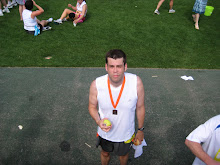
Two weeks until I run the marathon I've been training for since late July. I'm feeling pretty good about it; training has gone pretty well, and I'm confident I can meet the goals that I've set for myself. This is always a nice part of the training calendar. The big runs have all been completed, and I'm tapering for a couple of weeks. Sometimes the surfeit of energy produced by the taper can make me feel a little bit edgy, but it's better than being worn out and sore all the time the way I usually am at the height of marathon training.
In other news I'm reading Robert Browning's The Ring and the Book when I get a spare moment. It's not a book that people read much anymore--not even professional Victorianists such as myself. 600 pages of dense poetry has a way of taking people off their game. It's another sign--as if there weren't enough already--that poetry has long been taken off central stage in our society. It's sad really; it's beautiful, interesting, funny, intriguing, challenging verse novel that lies relatively dormant because no one--aside from a few specialists like myself--reads it anymore.
Saturday, October 3, 2009

Monday, August 31, 2009
Persuasion and Pleasure
Over the weekend I reread Jane Austen's Persuasion. The direct reason, of course, was that a student is doing her senior project on the novel, and she asked me to be the first reader for the paper. But I thoroughly enjoyed rereading it.
Austen's novels have been relentlessly adapted these past couple of decades. Around the time I was in college the now famous Colin Firth version of Pride and Prejudice came out, and that seems to have either created, or have been a part of, a tremendous revival of interest in the works of the regency-era novelist. Upon teaching her novels in a couple of different classes, I have usually tried to ask my students why all this interest; why do they seek out these films, and even, in some cases, actually read the novels? The students--usually overwhelmingly female in these cases--have responded that in these novels the men simply treat women as women. The men are kind, considerate, and even romantic. My students are not (or at least not all) naive conservatives. They do not, apparently, want to lose the right to own property, vote, and appear in public without a chaperon. They also, apparently, appreciate the benefits of modern plumbing and medicine, but perhaps that goes without saying. Jane Austen almost seems to function for them the way that porn does for others; it's a fantasy that that the person having the fantasy can recognize as unrealistic, perhaps even undesirable, but that meets some deep-seated need.
I like Persuasion because--at twenty-eight--the heroine is today's equivalent of a woman in her mid-forties. There's something sweet about the idea of this rather shy, kind woman finally getting the man that she lost when she was younger, and more powerless. I also simply enjoy the prose; Austen writes with a clarity and precision that was unusual then, and is completely gone now.
On a side note: the TV show Reading Rainbow has been canceled. I'm not sure what I can add that some other people haven't already said. I particularly liked what the 19th floor guy had to say. I haven't watched the show in years; I'm not even sure that the PBS affiliates I have been living around even carried the show, and of course I have no children that would have caused me to look it up. But I have very fond memories of watching that show on idle summer mornings growing up. It remains one of the few shows--that I remember--dedicated to the sheer pleasure of reading. So much of our society is about the utilitarianism of capitalism; everything must be justified in terms of its productivity. Yes, kids who are strong readers do better in school, are more likely to go to Harvard, make a six-figure salary. For me, the show reminded me that--even as I was growing out of the level of books promoted on the show--that reading was as much fun as Bugs Bunny and chocolate milk. It was pleasure, not homework.
Austen's novels have been relentlessly adapted these past couple of decades. Around the time I was in college the now famous Colin Firth version of Pride and Prejudice came out, and that seems to have either created, or have been a part of, a tremendous revival of interest in the works of the regency-era novelist. Upon teaching her novels in a couple of different classes, I have usually tried to ask my students why all this interest; why do they seek out these films, and even, in some cases, actually read the novels? The students--usually overwhelmingly female in these cases--have responded that in these novels the men simply treat women as women. The men are kind, considerate, and even romantic. My students are not (or at least not all) naive conservatives. They do not, apparently, want to lose the right to own property, vote, and appear in public without a chaperon. They also, apparently, appreciate the benefits of modern plumbing and medicine, but perhaps that goes without saying. Jane Austen almost seems to function for them the way that porn does for others; it's a fantasy that that the person having the fantasy can recognize as unrealistic, perhaps even undesirable, but that meets some deep-seated need.
I like Persuasion because--at twenty-eight--the heroine is today's equivalent of a woman in her mid-forties. There's something sweet about the idea of this rather shy, kind woman finally getting the man that she lost when she was younger, and more powerless. I also simply enjoy the prose; Austen writes with a clarity and precision that was unusual then, and is completely gone now.
On a side note: the TV show Reading Rainbow has been canceled. I'm not sure what I can add that some other people haven't already said. I particularly liked what the 19th floor guy had to say. I haven't watched the show in years; I'm not even sure that the PBS affiliates I have been living around even carried the show, and of course I have no children that would have caused me to look it up. But I have very fond memories of watching that show on idle summer mornings growing up. It remains one of the few shows--that I remember--dedicated to the sheer pleasure of reading. So much of our society is about the utilitarianism of capitalism; everything must be justified in terms of its productivity. Yes, kids who are strong readers do better in school, are more likely to go to Harvard, make a six-figure salary. For me, the show reminded me that--even as I was growing out of the level of books promoted on the show--that reading was as much fun as Bugs Bunny and chocolate milk. It was pleasure, not homework.
Friday, August 28, 2009
It's the end of the world as we know it, and I feel fine. . .
Last weekend I read Alas Babylon by Pat Frank. A student was thinking about doing his senior project on it, so I said I'd take a look. The novel--half-forgotten today--was almost certainly one of the first in a long series of cold-war era apocalyptic nuclear scenarios. A late 1950s Florida small town survives the initial nuclear attack from the USSR, while Miami, Jacksonville, Atlanta, Tampa Bay, and eventually Orlando go up in a mushroom cloud around it, along with quite a bit of the rest of the planet. The survivors, of course, have to fashion new modes of survival, including transportation, medicine, and a new economy.
The novel was amusing in at least one way that it probably wasn't when it was first published. The novel is almost charmingly dated--it was a bit like watching an episode of _Mad Men_, except one where the Cuban Missile crisis doesn't end well. Imagine Don Draper and Pete Campbell climbing over the ruins of a destroyed Florida, saying things like "Well, this is a fine donnybrook, I must say," and you might get a rough feel for the novel.
Frank apparently wrote the novel, in part, because he didn't think his contemporaries realized how bad a nuclear war could be. He wanted to show that the world would NOT get back to normal after a nuclear exchange, and today it's an interesting reminder that anyone ever thought that that would be the case; it goes a long way to explaining the early years of the cold war when you realize that people on both sides thought that a nuclear exchange would be like a conventional war, only more so. Frank wanted to point out that the U.S. would essentially turn back the clock of civilization by at least a couple of thousand years. From my perspective, Frank was still almost charmingly optimistic about nuclear annihilation. Within a year after The Day, his heroes and heroines have new food sources, new sexual partners, and a new economy. There's almost something bracingly Thoreauean (if I can use that word) about the whole thing: these people have had to simplify their lives with a vengeance, but after having done so, they seem to be enjoying themselves. Yeah, okay, there's the little matter of radiation poisoning, but, Frank seems to say, life ain't ever going to be perfect.
As I was reading, I also couldn't help think about the way in which recent fiction has turned its back on the nuclear scenario. My favorite 'end of the world as we know it' novel of the past few years is Margaret Atwood's Oryx and Crake, wherein an engineered super-virus, introduced into the world through vitamins, takes out all but a handful of engineered mutants. Despite the presence of thousands of nuclear warheads in the world, we're more worried about catching a super-cold these days.
The novel was amusing in at least one way that it probably wasn't when it was first published. The novel is almost charmingly dated--it was a bit like watching an episode of _Mad Men_, except one where the Cuban Missile crisis doesn't end well. Imagine Don Draper and Pete Campbell climbing over the ruins of a destroyed Florida, saying things like "Well, this is a fine donnybrook, I must say," and you might get a rough feel for the novel.
Frank apparently wrote the novel, in part, because he didn't think his contemporaries realized how bad a nuclear war could be. He wanted to show that the world would NOT get back to normal after a nuclear exchange, and today it's an interesting reminder that anyone ever thought that that would be the case; it goes a long way to explaining the early years of the cold war when you realize that people on both sides thought that a nuclear exchange would be like a conventional war, only more so. Frank wanted to point out that the U.S. would essentially turn back the clock of civilization by at least a couple of thousand years. From my perspective, Frank was still almost charmingly optimistic about nuclear annihilation. Within a year after The Day, his heroes and heroines have new food sources, new sexual partners, and a new economy. There's almost something bracingly Thoreauean (if I can use that word) about the whole thing: these people have had to simplify their lives with a vengeance, but after having done so, they seem to be enjoying themselves. Yeah, okay, there's the little matter of radiation poisoning, but, Frank seems to say, life ain't ever going to be perfect.
As I was reading, I also couldn't help think about the way in which recent fiction has turned its back on the nuclear scenario. My favorite 'end of the world as we know it' novel of the past few years is Margaret Atwood's Oryx and Crake, wherein an engineered super-virus, introduced into the world through vitamins, takes out all but a handful of engineered mutants. Despite the presence of thousands of nuclear warheads in the world, we're more worried about catching a super-cold these days.
Sunday, July 12, 2009
Managing Expectations
Right now I'm procrastinating on more important projects by working on a less important project. I might teach a science-fiction course spring semester 2010, so I've taken this as an excuse to read some science-fiction. I asked for some suggestions on facebook; I received a few. Some suggested graphic novels. Watchmen came up. So I checked it out, and finished reading it yesterday.
It was disappointing. I'd heard a lot about this particular work the past couple of years. I like comics; I grew up on a steady diet of Spider-Man, the Hulk, the Avengers, Iron Man, and Thor (speaking of which, where is Thor's feature film?). And I admit that Watchmen engaged comic book superhero tropes in some interesting and engaging ways. I think perhaps the book suffered from what I'll call the Casablanca or Citizen Kane syndrome. Watchmen obviously influenced an entire generation of comic books, films, even TV shows. By the time I read it (much in the same way as I saw those two films) it simply felt cliched. I'd seen this stuff before. Over and over again. Enough with the brooding, flawed super-heroes.
But of course, it's horribly unfair, because Watchmen, Casablanca, and Citizen Kane are the reasons those cliches exist; or at the very least, they helped those tropes become set through their own brilliance.
At any rate, I don't think Watchmen is going to make the cut; it mostly engages comic book tropes; the science-fiction genre, while occasionally making an appearance, takes a backseat to the series' attempts to reexamine classic comic book beats.
It was disappointing. I'd heard a lot about this particular work the past couple of years. I like comics; I grew up on a steady diet of Spider-Man, the Hulk, the Avengers, Iron Man, and Thor (speaking of which, where is Thor's feature film?). And I admit that Watchmen engaged comic book superhero tropes in some interesting and engaging ways. I think perhaps the book suffered from what I'll call the Casablanca or Citizen Kane syndrome. Watchmen obviously influenced an entire generation of comic books, films, even TV shows. By the time I read it (much in the same way as I saw those two films) it simply felt cliched. I'd seen this stuff before. Over and over again. Enough with the brooding, flawed super-heroes.
But of course, it's horribly unfair, because Watchmen, Casablanca, and Citizen Kane are the reasons those cliches exist; or at the very least, they helped those tropes become set through their own brilliance.
At any rate, I don't think Watchmen is going to make the cut; it mostly engages comic book tropes; the science-fiction genre, while occasionally making an appearance, takes a backseat to the series' attempts to reexamine classic comic book beats.
Friday, July 10, 2009
The Zen Koan that is Lance
As baseball fan, an occasional marathon and other track and field events enthusiast, and as an even more casual cycling fan, I've been reminded a lot of steroids issues lately. Lance Armstrong is riding again, and every one and their kid sister seems to have an opinion about Lance the person, Lance the cyclist, and Lance the alleged doper. Manny Ramirez has returned to play for the Dodgers after being suspended for 50 games; apparently he was taking a female fertility drug that 'roiders use when they come off a cycle.
There's probably not much I can add to these discussions. I have a hard time getting self-righteously indignant about doping anymore; it simply happens too often, and it's too exhausting to get upset that often. On the other hand I have a hard time blowing it off as 'that's what athletes do these days to compete' the way that some fans seem to have coped with it.
But on the new Slate sports gabfest, one of the commentators pointed out that we--as the sports watching populace--tend to treat these people differently based on whether we liked them before they got caught on steroids. Alex Rodridguez gets caught--no one liked him to begin with, so we come down on him like a ton of bricks. Manny does it, and we make jokes about the fact that even the drug he gets caught with is typical of his flaky weirdness. And we're thrilled when he starts hitting home runs in Dodger stadium again.
Which brings me to the strange phenomenon of Lance Armstrong. I can't think of any athlete who inspires--at least in me, anyway--the strange mixture of admiration and repulsion. There's enough circumstantial evidence that it's difficult for me to believe that he hasn't played around with EPO on occasion. And he's arrogant enough; he reminds you of high school jocks who thought that mastering their particular sport made them superior human beings in every respect. But at the same time, he has this odd redeeming quality. The cancer scare really seems to have got to him, and I believe him when he says that he is riding for cancer patients. There's something really off putting about the messiah complex so obvious in a commercial like "Driven;" there's something appealing about an athlete doing something in addition to trying to notch another victory. Make no mistake about it: Lance intends to win his eighth Tour de France. But make no mistake about it; he also really believes he's doing it for the 12 year old recovering from cancer.
There's probably not much I can add to these discussions. I have a hard time getting self-righteously indignant about doping anymore; it simply happens too often, and it's too exhausting to get upset that often. On the other hand I have a hard time blowing it off as 'that's what athletes do these days to compete' the way that some fans seem to have coped with it.
But on the new Slate sports gabfest, one of the commentators pointed out that we--as the sports watching populace--tend to treat these people differently based on whether we liked them before they got caught on steroids. Alex Rodridguez gets caught--no one liked him to begin with, so we come down on him like a ton of bricks. Manny does it, and we make jokes about the fact that even the drug he gets caught with is typical of his flaky weirdness. And we're thrilled when he starts hitting home runs in Dodger stadium again.
Which brings me to the strange phenomenon of Lance Armstrong. I can't think of any athlete who inspires--at least in me, anyway--the strange mixture of admiration and repulsion. There's enough circumstantial evidence that it's difficult for me to believe that he hasn't played around with EPO on occasion. And he's arrogant enough; he reminds you of high school jocks who thought that mastering their particular sport made them superior human beings in every respect. But at the same time, he has this odd redeeming quality. The cancer scare really seems to have got to him, and I believe him when he says that he is riding for cancer patients. There's something really off putting about the messiah complex so obvious in a commercial like "Driven;" there's something appealing about an athlete doing something in addition to trying to notch another victory. Make no mistake about it: Lance intends to win his eighth Tour de France. But make no mistake about it; he also really believes he's doing it for the 12 year old recovering from cancer.
Friday, July 3, 2009
I'm back. Again. Maybe.
A couple of thoughts as I try to return to this format:
1. I’m doing this to get myself writing again, in any format, in any way. Most of the past year was completely swamped by teaching, and I simply need to write more: professionally, and for my own satisfaction.
2. I need to be more concise. My favorite blogs, I’ve noticed, keep it relatively short. My favorite blog right now, the 19th floor, usually comes in around two or three paragraphs.
3. I also need to write more often. I check blogs more often that I know are going to be updated more often.
4. Perhaps I need to not limit myself to my workouts or my current reading. Most running blogs I breeze through get pretty boring if they focus on running alone. This probably should have been obvious to me much sooner, but I can be dense.
That being said, I will mention that I’m reading Evelyn Waugh’s Brideshead Revisited. I’m trying to make up my mind if I like it. I saw the mini-series that Jeremy Irons starred in a couple of decades ago. Waugh’s prose is—well any adjective I use is going to sound trite—but it’s sort of delicious in an overly rich pastry sort of way; it’s heavy on the nostalgia to an almost cloying degree. On the professional side I’m reading Darwin’s Sacred Cause, which is a history of Darwin’s relationship to the abolitionist cause. I’d say it was interesting, and it is, to me, but this up my particular professional alley, and I can have a bit of a blind spot when it comes to that sort of thing.
Since I last wrote, I also bought a Trek 1.5 road bike. There’s little ambivalence there. Despite being occasionally left in the dust by the local cycling club, I have to say that I love cycling. I’d be doing a lot more of it right now if I weren’t trying to focus on training for another marathon in Grand Rapids. Despite these humid South Georgia summers, rides in the morning take on this wonderful meditative quality.
Enough for now. More soon, hopefully.
Saturday, December 13, 2008
I'm back. I think.
It's hard to believe that it's been August since I last posted. I suppose that was roughly when the term started. It's been a four months of teaching at full speed: class prep, grading, and the odd committee meeting (and when I say odd. . . .).
Still, over Thanksgiving I read a book that had me thinking I should start again. The book was What I Talk about When I Talk about Running by Haruki Murakami. It's a short book; I read it quickly over a couple of days. It's a memoir about Murakami's running life. He took up running when he began to write novels in his late twenties. He gave up his jazz club so that he could focus on running, and when he did so, he began to gain weight. Running became the solution. At the time of running he had posted well over twenty marathons, at about the rate of one a year, and a number of triatholons of various distances.
The interesting thing about it is how hard Murakami is on himself. His times still frustrate him. His aging body frustrates him. And his times are impressive, at any age. They aren't Olympic impressive, but he's obviously a solid athlete, as well as an award winning novelist. The book is simply written, but compelling somehow; perhaps it is because--even though he doesn't talk about traditionally 'personal' subjects--the book feels so personal because Murakami feels that running is so personally important to him.
I am neither the athlete nor the writer that Murakami is, but I did relate to him on that level. Even the title seems to get at something. Running--and other distance athletic activities--are odd, and hard to understand for those who have no interest in doing them. And yet it has--in the past few years--become incredibly important to me personally as well, for reasons that I can't quite describe to myself. Like Murakami I became serious about it in my late twenties. In my case it was when I was beginning the process of writing my Ph.D dissertation, which was a marathon in of itself. My goal was to finish a marathon before I defended my dissertation, and I met that goal with about nine months to go.
I haven't raced since May. I've been too busy with school and other act ivies. I've still been running; I could run a reasonably competent half on short notice I think. Still, I've been thinking that it's time to start planning for another half and a full in the spring, in no small part because of Murakami's book.
Still, over Thanksgiving I read a book that had me thinking I should start again. The book was What I Talk about When I Talk about Running by Haruki Murakami. It's a short book; I read it quickly over a couple of days. It's a memoir about Murakami's running life. He took up running when he began to write novels in his late twenties. He gave up his jazz club so that he could focus on running, and when he did so, he began to gain weight. Running became the solution. At the time of running he had posted well over twenty marathons, at about the rate of one a year, and a number of triatholons of various distances.
The interesting thing about it is how hard Murakami is on himself. His times still frustrate him. His aging body frustrates him. And his times are impressive, at any age. They aren't Olympic impressive, but he's obviously a solid athlete, as well as an award winning novelist. The book is simply written, but compelling somehow; perhaps it is because--even though he doesn't talk about traditionally 'personal' subjects--the book feels so personal because Murakami feels that running is so personally important to him.
I am neither the athlete nor the writer that Murakami is, but I did relate to him on that level. Even the title seems to get at something. Running--and other distance athletic activities--are odd, and hard to understand for those who have no interest in doing them. And yet it has--in the past few years--become incredibly important to me personally as well, for reasons that I can't quite describe to myself. Like Murakami I became serious about it in my late twenties. In my case it was when I was beginning the process of writing my Ph.D dissertation, which was a marathon in of itself. My goal was to finish a marathon before I defended my dissertation, and I met that goal with about nine months to go.
I haven't raced since May. I've been too busy with school and other act ivies. I've still been running; I could run a reasonably competent half on short notice I think. Still, I've been thinking that it's time to start planning for another half and a full in the spring, in no small part because of Murakami's book.
Sunday, August 17, 2008
Man in the Dark
So, it's been awhile. Not quite two months. Not that anyone is much reading this, I suspect, but still, for the 1, possibly 3, loyal readers out there, I feel like I've let you down. It's been a hectic summer to say the least. Last time I posted I was still in Indiana. Now I'm in South Georgia, just miles away from the Florida border. So that's one reason it's been awhile. There are others.
BUT, I finished a book tonight that had nothing to do with the job (another reason) I've been starting down here in Dixie. That book was Paul Auster's Man in the Dark. It's a short little novel--a novella almost, about an aging writer/critic experiencing insomnia. Since insomnia is something I regularly deal with myself, I've always found that particular topic especially interesting.
So it's a good book, but it feels, even in 180 rather generously lined pages, a little unfocused. At least one half of the first half (if that makes sense) of the novel is given to a character that that August (our central insomniac) is creating in his head to while away the sleepless hours. The reader gets interested in this meta-fictional character, and the rather odd predicament he finds himself in (he's supposed to kill his creator) and then Auster, using August, kills him off rather unceremoniously. I get the feeling that this meta-fictional character is supposed to tell us something about the domestic plot that August is involved in with his daughter and grand-daughter. Perhaps I'm obtuse, but I never got the connection.
It's like a New Yorker short story got involved with a Charlie Kaufman screenplay, but no one ever bothered to explain the connection. It's not a bad idea, perhaps even a good one, but I needed something a little more obvious to make it all make sense.
What else to tell? I'm trying to learn to run in the Georgia humidity. Honestly it hasn't been that bad so far, but the locals tell me this is a pretty moderate summer. Apparently we're going to get some hurricane inspired rain later in the week. So, THAT should be interesting.
BUT, I finished a book tonight that had nothing to do with the job (another reason) I've been starting down here in Dixie. That book was Paul Auster's Man in the Dark. It's a short little novel--a novella almost, about an aging writer/critic experiencing insomnia. Since insomnia is something I regularly deal with myself, I've always found that particular topic especially interesting.
So it's a good book, but it feels, even in 180 rather generously lined pages, a little unfocused. At least one half of the first half (if that makes sense) of the novel is given to a character that that August (our central insomniac) is creating in his head to while away the sleepless hours. The reader gets interested in this meta-fictional character, and the rather odd predicament he finds himself in (he's supposed to kill his creator) and then Auster, using August, kills him off rather unceremoniously. I get the feeling that this meta-fictional character is supposed to tell us something about the domestic plot that August is involved in with his daughter and grand-daughter. Perhaps I'm obtuse, but I never got the connection.
It's like a New Yorker short story got involved with a Charlie Kaufman screenplay, but no one ever bothered to explain the connection. It's not a bad idea, perhaps even a good one, but I needed something a little more obvious to make it all make sense.
What else to tell? I'm trying to learn to run in the Georgia humidity. Honestly it hasn't been that bad so far, but the locals tell me this is a pretty moderate summer. Apparently we're going to get some hurricane inspired rain later in the week. So, THAT should be interesting.
Tuesday, June 24, 2008
Deducing Reality
I read a Michael Chabon novel after finishing his book of essays (Maps and Legends). The novel in question was The Final Solution. Novella might be a more appropriate term--it was pretty short.
It was pretty good. An ancient Sherlock Holmes, obviously in his last days, helps a young boy German Jew, displaced by the second World War, to find his stolen parrot. As stories go, it shows what you can achieve by not over explaining the plot. Chabon refuses to explicate everything for us; instead we, as readers, have to participate in making some sense out of the novella's events. Combined with the elaborate descriptions, the result is feeling like you are actually present for the story. And not in that irritating way that I've seen in some recent novels, where you get the feeling the author has one eye on a film option as they are typing (The Historian, I'm looking in your direction). I don't mean that you see the action, but rather you feel like you are present for it. Considering that one chapter is in the third person limited perspective of a parrot, this is a trick.
Some of the things that I found mildly annoying about the novel can actually be excused because of this. Chabon, for instance, refuses to name Holmes, instead referring to him as the 'old man' and forcing the reader to deduce who the old man actually is. I couldn't decide if I found that little feature annoying or charming. I settled on teasing after awhile. And some of the prose--when describing certain physical details--felt a little overwritten. Adjective happy, I might say, if it was handed to me in an undergraduate paper. But as I think about the overall effect I think I see what Chabon was going for. The overall result--the intense physical descriptions, the refusal to interpret events and plot points, even the coyness over the name of a central character--is that you are thrust into the novel's action, much like you are thrown into life. You are bombarded with sense detail and forced to make a coherent interpretation of it. Considering the vocation of the main character, this seems appropriate.
It was pretty good. An ancient Sherlock Holmes, obviously in his last days, helps a young boy German Jew, displaced by the second World War, to find his stolen parrot. As stories go, it shows what you can achieve by not over explaining the plot. Chabon refuses to explicate everything for us; instead we, as readers, have to participate in making some sense out of the novella's events. Combined with the elaborate descriptions, the result is feeling like you are actually present for the story. And not in that irritating way that I've seen in some recent novels, where you get the feeling the author has one eye on a film option as they are typing (The Historian, I'm looking in your direction). I don't mean that you see the action, but rather you feel like you are present for it. Considering that one chapter is in the third person limited perspective of a parrot, this is a trick.
Some of the things that I found mildly annoying about the novel can actually be excused because of this. Chabon, for instance, refuses to name Holmes, instead referring to him as the 'old man' and forcing the reader to deduce who the old man actually is. I couldn't decide if I found that little feature annoying or charming. I settled on teasing after awhile. And some of the prose--when describing certain physical details--felt a little overwritten. Adjective happy, I might say, if it was handed to me in an undergraduate paper. But as I think about the overall effect I think I see what Chabon was going for. The overall result--the intense physical descriptions, the refusal to interpret events and plot points, even the coyness over the name of a central character--is that you are thrust into the novel's action, much like you are thrown into life. You are bombarded with sense detail and forced to make a coherent interpretation of it. Considering the vocation of the main character, this seems appropriate.
Monday, June 23, 2008
My favorite Star Trek episode is the one with Joan Collins--"The City on the Edge of Forever"
Tonight I finished reading a collection of essays by Michael Chabon, Maps and Legends. The sticker on the back tells me that it is his first book of nonfiction, and then lists a bunch of the novels he has written. I've heard of them; two of them are on our bookshelves, but I haven't read them yet. I did see the film version of Wonder Boys, which I now understand was based on a novel he wrote.
Anyway, it was good. Several essays on comic books/strips, and there were a couple of rants about biases against popular genre fiction, so he had me pretty much from the time he pointed out that science-fiction gets relegated to the generic ghetto just behind the bourgeois suburb of realism. Sometimes I think he may have overstated the case just a bit--sci-fi and detective fiction have been coming up in the world of academia. But I also suspect this may come from our different perspectives. Chabon is a product of an MFA program; I'm a product of literature graduate programs. MFA students always strike me as desperate to be taken seriously; literature students--some of them anyway--always strike me as desperate not to be taken for the snobs we actually are. So literature students drop pointed references to Buffy, the X-Men, and discuss the narrative virtues of video games--even if they do their academic work on Jonathan Swift or Chaucer. MFA students keep writing earnest realism, or even more painfully earnest poetry, and turn their noses up at any narrative with a spaceship or a detective in it. Gross oversimplification, I'm sure, but I've seen enough of graduate school to suspect that it's a rough guide to how things work in your local English department.
The last essay--a kind of digression within an essay within an memoir within a religious reflection--was especially good. It's about a lot of things, but early on Chabon talks about finding a book entitled Strangely Enough! on the YA rack at his local library. The book sounds like a lot of books I remember reading avidly as a kid; the cheap paper back with chapters on UFOs, the possibility of time travel, what made the dinosaurs go extinct, Nostradamus, etc. That portion of the essay evoked some of the real pleasure that reading gave me as a child; memories of long summer afternoons, comic books, Godzilla movies on my grandmother's TV, and choose-your-own adventure books came flooding back. I've been watching some Twilight Zone reruns at night recently, and they've been producing the same effect. One of these nights the wife is going to come out and catch me reading Ray Bradbury and inhaling Fig Newtons. Oh wait. . . .
Anyway--where does that pleasure go? I still enjoy reading. I've made reading literature my life's work. But the trouble with gorging yourself, I suppose, is that you always run the risk of satiation, even cynicism. I haven't become cynical just yet--today I caught myself actually enjoying reviewing some Wordsworth poetry for a class I'm preparing for the fall. But it gets difficult to access that unalloyed pleasure of the text that you had when were a child. You catch yourself--in the middle of a hokey Star Trek rerun--reflecting on the cold war politics that must have shaped the way that the Romulans were written into that show.
But of course, that's a pleasure in and of itself too.
Anyway, it was good. Several essays on comic books/strips, and there were a couple of rants about biases against popular genre fiction, so he had me pretty much from the time he pointed out that science-fiction gets relegated to the generic ghetto just behind the bourgeois suburb of realism. Sometimes I think he may have overstated the case just a bit--sci-fi and detective fiction have been coming up in the world of academia. But I also suspect this may come from our different perspectives. Chabon is a product of an MFA program; I'm a product of literature graduate programs. MFA students always strike me as desperate to be taken seriously; literature students--some of them anyway--always strike me as desperate not to be taken for the snobs we actually are. So literature students drop pointed references to Buffy, the X-Men, and discuss the narrative virtues of video games--even if they do their academic work on Jonathan Swift or Chaucer. MFA students keep writing earnest realism, or even more painfully earnest poetry, and turn their noses up at any narrative with a spaceship or a detective in it. Gross oversimplification, I'm sure, but I've seen enough of graduate school to suspect that it's a rough guide to how things work in your local English department.
The last essay--a kind of digression within an essay within an memoir within a religious reflection--was especially good. It's about a lot of things, but early on Chabon talks about finding a book entitled Strangely Enough! on the YA rack at his local library. The book sounds like a lot of books I remember reading avidly as a kid; the cheap paper back with chapters on UFOs, the possibility of time travel, what made the dinosaurs go extinct, Nostradamus, etc. That portion of the essay evoked some of the real pleasure that reading gave me as a child; memories of long summer afternoons, comic books, Godzilla movies on my grandmother's TV, and choose-your-own adventure books came flooding back. I've been watching some Twilight Zone reruns at night recently, and they've been producing the same effect. One of these nights the wife is going to come out and catch me reading Ray Bradbury and inhaling Fig Newtons. Oh wait. . . .
Anyway--where does that pleasure go? I still enjoy reading. I've made reading literature my life's work. But the trouble with gorging yourself, I suppose, is that you always run the risk of satiation, even cynicism. I haven't become cynical just yet--today I caught myself actually enjoying reviewing some Wordsworth poetry for a class I'm preparing for the fall. But it gets difficult to access that unalloyed pleasure of the text that you had when were a child. You catch yourself--in the middle of a hokey Star Trek rerun--reflecting on the cold war politics that must have shaped the way that the Romulans were written into that show.
But of course, that's a pleasure in and of itself too.
Friday, June 20, 2008
Why you should probably take it easy after a marathon. . .
So last Friday, I went out for a run. The plan; a five or six mile run at a pretty relaxed pace; my muscles were still protesting a bit if I try to put too much stress on them; the marathon was only two weeks into the past. The plan didn't work out.
One mile in, I stopped where the path crosses a fairly busy road, and was promptly slammed with pain. Later, people in the ER would ask: is it a dull pain, a stabbing pain? It was both, and more. I could hardly stand up, and it was difficult to breath. I ended up sitting down on the path for a bit, trying to figure out what was happening. The obvious occurred to me too, and I felt for my pulse. It was fine; good even, considering I'd just run a mile, it was downright slow. It was difficult to believe I was having a heart attack. After a bit, I managed to get up and walk, very slowly home.
The pain persisted at home, and the wife persisted that I needed to visit the ER. The pain was bad enough, and random enough, and I was scared enough, that I eventually agreed. The ER took me in and promptly hooked me up to all kinds of machines, after shaving two little bald spots in my chest hair. They put an IV hook up in my arm. At this point the wife went from looking concerned to downright terrified.
Anyway--to get to how this story turns out--the ER decided it was 'chest wall pain' which I thought was one of those hoax diagnoses. "Doctor, my arm hurts," I say. "Yes, I am a doctor, and I went to medical school where I learned that you have what is called--in the medical community--ARM PAIN! Take some Advil. Call me next week. That will be a billion dollars." That's kind of what happened.
Well, not quite. To be fair, the staff at the ER was extremely competent, and did all kinds of tests to rule out heart attack, cardiac arrest, blood clots, etc. I looked up 'chest wall pain' on the Google machine, and it turns out that it is this odd syndrome that no one seems to know much about. Since people don't really die of it--I guess--there isn't a lot of research money being funneled that way.
So I spent Saturday of last week flat on my back popping Advil every few hours while this Bob Seger tribute band played outside my apartment window. I did the reverse stages of grief with that band. When they first started playing at noon I accepted it, and was grateful that they were at least competent. By 8pm, the fourth or fifth repetition of "Still the Same" was wearing thin, and I was both angry and in denial at the same time. By 9pm I was in a very dark emotional hole.
The lesson kids? Don't lift a bunch of weights and go for a mile and half swim at a brisk pace shortly after running a marathon. And don't live across from the site of a motorcycle rally with questionable taste in hiring tribute bands if you can help it.
One mile in, I stopped where the path crosses a fairly busy road, and was promptly slammed with pain. Later, people in the ER would ask: is it a dull pain, a stabbing pain? It was both, and more. I could hardly stand up, and it was difficult to breath. I ended up sitting down on the path for a bit, trying to figure out what was happening. The obvious occurred to me too, and I felt for my pulse. It was fine; good even, considering I'd just run a mile, it was downright slow. It was difficult to believe I was having a heart attack. After a bit, I managed to get up and walk, very slowly home.
The pain persisted at home, and the wife persisted that I needed to visit the ER. The pain was bad enough, and random enough, and I was scared enough, that I eventually agreed. The ER took me in and promptly hooked me up to all kinds of machines, after shaving two little bald spots in my chest hair. They put an IV hook up in my arm. At this point the wife went from looking concerned to downright terrified.
Anyway--to get to how this story turns out--the ER decided it was 'chest wall pain' which I thought was one of those hoax diagnoses. "Doctor, my arm hurts," I say. "Yes, I am a doctor, and I went to medical school where I learned that you have what is called--in the medical community--ARM PAIN! Take some Advil. Call me next week. That will be a billion dollars." That's kind of what happened.
Well, not quite. To be fair, the staff at the ER was extremely competent, and did all kinds of tests to rule out heart attack, cardiac arrest, blood clots, etc. I looked up 'chest wall pain' on the Google machine, and it turns out that it is this odd syndrome that no one seems to know much about. Since people don't really die of it--I guess--there isn't a lot of research money being funneled that way.
So I spent Saturday of last week flat on my back popping Advil every few hours while this Bob Seger tribute band played outside my apartment window. I did the reverse stages of grief with that band. When they first started playing at noon I accepted it, and was grateful that they were at least competent. By 8pm, the fourth or fifth repetition of "Still the Same" was wearing thin, and I was both angry and in denial at the same time. By 9pm I was in a very dark emotional hole.
The lesson kids? Don't lift a bunch of weights and go for a mile and half swim at a brisk pace shortly after running a marathon. And don't live across from the site of a motorcycle rally with questionable taste in hiring tribute bands if you can help it.
Wednesday, June 4, 2008
The art of racing in the heat
The marathon did not go as hoped.
Let me explain. I'd run two marathons previous to this one. In 2005 (Chicago), my first, I finished in about 4 hours and 51 minutes. Not great, I'll grant you, but it was my first, and I'd only been running with any kind of seriousness for about a year and half or so. In the fall of 2006, I ran a marathon in Grand Rapids, and finished in 4:27. It was better, but not enough better. I really wanted to finish in under four hours. That was the goal. I decided I'd try again in the spring of 2007, here in South Bend. For various reasons, that didn't work out, and I ended up scaling back to the half. So that's the marathon history.
But then there is the half marathon history. In April I ran a half in 1:41. Last fall, I ran one in 1:45. I've run a couple of others in 1:48 and 1:53. Looking at those handy charts I sometimes find, I was led to believe that my 1:41 half in April meant that I was potentially capable of a 3:31 full in late May. I didn't really believe that, but I thought that a 1:41 half meant a cake walk to a sub 4:00 marathon. Or, as much as any full marathon can be cake walk.
But no. 4:26. Barely an improvement on last time. A lot went wrong. It was 70 degrees out at the 6:00 start time. I went out too hard, too fast. As is always the case with the Sunburst, we got the first viciously hot day of the summer on race day. My great half time in April may have been the problem as well; it may not have been a great idea to go all out back in April in the middle of marathon training.
Next time, marathon. Next time.
So, the next day after the race, I drove to Georgia. On the trip, I read The Art of Racing in the Rain. It was really very good. The novel's first person narrator is a dog named Enzo who belongs to an aspiring race car driver. The dog--educated by a PBS documentary on dogs in Mongolia--firmly believes that this existence is his last before he is granted a human life in the next existence.
It all sounds a bit precious. But the author--whose name escapes me at the moment--pulls it off brilliantly. And the novel is not solely about being a dog or a race car driver. Enzo's owner gets married, has a child, watches his wife die from a brain tumor, and has a drawn out custody battle with his in-laws for his daughter.
One of the the things that marks a great writer, I think, is the ability to make you care about something you didn't care about. I've always found auto racing a bit odd--a car doing laps? Really? But The Art of Racing in the Rain made auto racing make sense for me. The competition, the strategy, the machines, the speed, all became clear to me in a few beautifully written passages. Towards the end of the novel, the dog watches his owner racing karts with his six year old daughter, and the investment in racing descriptions pays. The pride the father feels in his six year old's driving skills, and the importance of that pride in that section of the novel, makes for a compelling scene. And the writer can leave it understated to some degree, because he's already put the reader in the position of understanding racing, parenthood, and loss.
Let me explain. I'd run two marathons previous to this one. In 2005 (Chicago), my first, I finished in about 4 hours and 51 minutes. Not great, I'll grant you, but it was my first, and I'd only been running with any kind of seriousness for about a year and half or so. In the fall of 2006, I ran a marathon in Grand Rapids, and finished in 4:27. It was better, but not enough better. I really wanted to finish in under four hours. That was the goal. I decided I'd try again in the spring of 2007, here in South Bend. For various reasons, that didn't work out, and I ended up scaling back to the half. So that's the marathon history.
But then there is the half marathon history. In April I ran a half in 1:41. Last fall, I ran one in 1:45. I've run a couple of others in 1:48 and 1:53. Looking at those handy charts I sometimes find, I was led to believe that my 1:41 half in April meant that I was potentially capable of a 3:31 full in late May. I didn't really believe that, but I thought that a 1:41 half meant a cake walk to a sub 4:00 marathon. Or, as much as any full marathon can be cake walk.
But no. 4:26. Barely an improvement on last time. A lot went wrong. It was 70 degrees out at the 6:00 start time. I went out too hard, too fast. As is always the case with the Sunburst, we got the first viciously hot day of the summer on race day. My great half time in April may have been the problem as well; it may not have been a great idea to go all out back in April in the middle of marathon training.
Next time, marathon. Next time.
So, the next day after the race, I drove to Georgia. On the trip, I read The Art of Racing in the Rain. It was really very good. The novel's first person narrator is a dog named Enzo who belongs to an aspiring race car driver. The dog--educated by a PBS documentary on dogs in Mongolia--firmly believes that this existence is his last before he is granted a human life in the next existence.
It all sounds a bit precious. But the author--whose name escapes me at the moment--pulls it off brilliantly. And the novel is not solely about being a dog or a race car driver. Enzo's owner gets married, has a child, watches his wife die from a brain tumor, and has a drawn out custody battle with his in-laws for his daughter.
One of the the things that marks a great writer, I think, is the ability to make you care about something you didn't care about. I've always found auto racing a bit odd--a car doing laps? Really? But The Art of Racing in the Rain made auto racing make sense for me. The competition, the strategy, the machines, the speed, all became clear to me in a few beautifully written passages. Towards the end of the novel, the dog watches his owner racing karts with his six year old daughter, and the investment in racing descriptions pays. The pride the father feels in his six year old's driving skills, and the importance of that pride in that section of the novel, makes for a compelling scene. And the writer can leave it understated to some degree, because he's already put the reader in the position of understanding racing, parenthood, and loss.
Friday, May 30, 2008
Been awhile. . .
since I last posted anything. I really meant to post at least once a week. But, as it so often does, life intervenes. I had to wrap up the semester, which always means a little extra work, and then a family member passed away, and I had to fly out to Oregon for a week. I'm also very aware of my impending move at the end of the summer, and I'm already in full planning mode for that. I'm taking a new job this fall, and that means that I've also been trying to get new courses organized and planned in advance. And now that I'm tenure-track, I'm trying to professionalize a bit and get back to my scholarly publishing schedule. So no, the blog just didn't get fit in for a few weeks.
A few things in passing:
Favorite Run of the past few weeks. . . was a few weeks ago on the Oregon coast. I ran from the beach house my parents had rented in Yahacts to the bay in Waldport about 8 miles north and back. Beautiful weather. The tide was coming in on my way back and that made for a challenging last 3 or 4 miles.
Favorite Book of the past few weeks . . . had to be Ursula K. Le Guin's anthology of early work Worlds of Exile and Illusion. I had ready Frederick Pohl's horrendously dreadful At the End of Time shortly before this, and Le Guin's early novels reminded me that yes, good writing and science-fiction are not mutually exclusive. Le Guin's work vaguely reminded me of the Asimov's Foundation novels--in their wide sweeping vision of a populated galaxy--but Le Guin's novels, even in this early period, are more elegant, more imaginative, and well, just BETTER.
A few other reads: The House at Riverton--picked this up off the wife's massive stack of new releases (the wife--if I haven't mentioned this before--gets sent massive numbers of just released books for free as a perk/requirement of her particular occupation). If you like Edwardian stories about butlers, maids, valets, cooks, and kitchen maids (and you can explain the difference in those positions) then you'll probably enjoy the novel. But you might just want to rent The Remains of the Day or Gosford Park or watch some Upstairs/Downstairs reruns, because there's not a whole lot in this novel that's new or different from them. Some of the characters seem to have been directly copied from Up/Down.
I'm also reading The Philosopher's Apprentice--another random pick from the massive mounds of hardbacks with which my wife insists on surrounding our bed. (Come to think of it, there's a metaphor for my life in a marriage bed surrounded by books, but I don't really want to go there right now). The book--the tale of an ABD philosopher-in-ethics who manages to teach a genetic clone to have a conscience, and the subsequent aftermath, is an interesting mess. If you enjoy a lot of references to Heidegger, Decartes, Jesus, and Plato while reading about armies of cloned aborted fetuses tormenting the parents who cast them away, then this is the book for you. It is an interesting read, I just think it should be packaged with the pot that is so obviously necessary to its complete enjoyment.
Oh yeah, then there was Pohl's At the End of the Time, but I think I mentioned that that sucked. Seriously, that book was BAD and left a bad taste in my mouth for weeks.
I also reread Trollope's Can You Forgive Her? which I'm pretty sure is brilliant. But that's for work, and I'm trying to keep work out of this.
Also good: Elizabeth Gaskell's Cranford. Yes, I watch PBS, and their television version got me interested in the book. It's not so much a novel as a patchwork of interrelated short stories, but if you enjoy Victorian fiction, then you'll probably enjoy this. If you enjoy the dramas they make out of nineteenth-century fiction, which are always cutely loaded with a romantic comedy with costumes, but aren't so sure about the actual books themselves, I can't gurantee anything. The cutesy love story from TV is completely absent in the book.
So, in about 45 minutes I'm going to wander downtown and pick up my race packet for the marathon. I'm surprised to find myself so excited. I've gotten so geeky about this running thing. If you'd told me that I'd be this way about a race five years ago I would have asked you what drugs you were on, and if I could have some.
A few things in passing:
Favorite Run of the past few weeks. . . was a few weeks ago on the Oregon coast. I ran from the beach house my parents had rented in Yahacts to the bay in Waldport about 8 miles north and back. Beautiful weather. The tide was coming in on my way back and that made for a challenging last 3 or 4 miles.
Favorite Book of the past few weeks . . . had to be Ursula K. Le Guin's anthology of early work Worlds of Exile and Illusion. I had ready Frederick Pohl's horrendously dreadful At the End of Time shortly before this, and Le Guin's early novels reminded me that yes, good writing and science-fiction are not mutually exclusive. Le Guin's work vaguely reminded me of the Asimov's Foundation novels--in their wide sweeping vision of a populated galaxy--but Le Guin's novels, even in this early period, are more elegant, more imaginative, and well, just BETTER.
A few other reads: The House at Riverton--picked this up off the wife's massive stack of new releases (the wife--if I haven't mentioned this before--gets sent massive numbers of just released books for free as a perk/requirement of her particular occupation). If you like Edwardian stories about butlers, maids, valets, cooks, and kitchen maids (and you can explain the difference in those positions) then you'll probably enjoy the novel. But you might just want to rent The Remains of the Day or Gosford Park or watch some Upstairs/Downstairs reruns, because there's not a whole lot in this novel that's new or different from them. Some of the characters seem to have been directly copied from Up/Down.
I'm also reading The Philosopher's Apprentice--another random pick from the massive mounds of hardbacks with which my wife insists on surrounding our bed. (Come to think of it, there's a metaphor for my life in a marriage bed surrounded by books, but I don't really want to go there right now). The book--the tale of an ABD philosopher-in-ethics who manages to teach a genetic clone to have a conscience, and the subsequent aftermath, is an interesting mess. If you enjoy a lot of references to Heidegger, Decartes, Jesus, and Plato while reading about armies of cloned aborted fetuses tormenting the parents who cast them away, then this is the book for you. It is an interesting read, I just think it should be packaged with the pot that is so obviously necessary to its complete enjoyment.
Oh yeah, then there was Pohl's At the End of the Time, but I think I mentioned that that sucked. Seriously, that book was BAD and left a bad taste in my mouth for weeks.
I also reread Trollope's Can You Forgive Her? which I'm pretty sure is brilliant. But that's for work, and I'm trying to keep work out of this.
Also good: Elizabeth Gaskell's Cranford. Yes, I watch PBS, and their television version got me interested in the book. It's not so much a novel as a patchwork of interrelated short stories, but if you enjoy Victorian fiction, then you'll probably enjoy this. If you enjoy the dramas they make out of nineteenth-century fiction, which are always cutely loaded with a romantic comedy with costumes, but aren't so sure about the actual books themselves, I can't gurantee anything. The cutesy love story from TV is completely absent in the book.
So, in about 45 minutes I'm going to wander downtown and pick up my race packet for the marathon. I'm surprised to find myself so excited. I've gotten so geeky about this running thing. If you'd told me that I'd be this way about a race five years ago I would have asked you what drugs you were on, and if I could have some.
Saturday, April 26, 2008
Running sans ipod. . .
is exactly what I did last week when I ran the Valpo half marathon. For those of you keeping score at home (and I suspect that total is exactly zero) I ran that 13.1 miles in 1:41:09. Or something approximating that. It was about a 7:43, 7:44 average pace. But the point is--it was the first race I ran without music. Since they've technically been banned from sanctioned events (most people wear them anyway) I've been experimenting with doing long runs without them.
To my suprise, I've found I've enjoyed it. During the race I actually got to have a few conversations with fellow runners. And you feel--if you'll forgive the slightly new agey feel to this--more connected to your own body as you run. I still enjoy the ipod, especially doing intervals--everyone wants to feel badass when they are doing speedwork--but the long runs take on this kinetic energy of their own when you run sans music. And running sans ipod didn't seem to hurt my time. That half last Saturday was a PR.
Book of the Week: A People's History of American Empire by Howard Zinn.
It's a graphic history version. The book goes through the U.S.'s efforts--despite its own stated rhetoric--to control and manipulate colonial interests. It is, as you might imagine, depressing. Anyone for a comic book version of Wounded Knee? A real barrel of laughs it isn't.
But a slightly more important problem: it lacks context and nuance. Take the Wounded Knee massacre for instance. That was an awful chapter in American history. But because of the way it is presented in this book it isn't clear what motivated that massacre, what followed it, and the way it impacted the continuing history of Native Americans and their continuing interactions with the American government. We just roll on to the next atrocity, and the next time that America hypocritically intervened in another people's history, ostensibly to help them, but really to allocate resources for ourselves. This 'greatest hits' approach to American Empire's most awful moments superficially points out that the U.S. often hasn't lived up to its democratic ideals, but fails to diagnose, with any real nuance, the underlying problems, whatever they may be.
Am I expecting too much from a graphic book? I don't think so. I've read some really perceptive graphic memoirs as of late that presented nuance and sophistication in their approach to complex psychological problems. Why can't I expect trenchant political and historical analysis from a graphic history? I'm sure the book's author and the people who produced the book will argue that quite a few people simply need to be reminded that this history exists. And they are, sadly, probably too correct.
But that's what I read last week. I hope whoever reads this is doing well.
To my suprise, I've found I've enjoyed it. During the race I actually got to have a few conversations with fellow runners. And you feel--if you'll forgive the slightly new agey feel to this--more connected to your own body as you run. I still enjoy the ipod, especially doing intervals--everyone wants to feel badass when they are doing speedwork--but the long runs take on this kinetic energy of their own when you run sans music. And running sans ipod didn't seem to hurt my time. That half last Saturday was a PR.
Book of the Week: A People's History of American Empire by Howard Zinn.
It's a graphic history version. The book goes through the U.S.'s efforts--despite its own stated rhetoric--to control and manipulate colonial interests. It is, as you might imagine, depressing. Anyone for a comic book version of Wounded Knee? A real barrel of laughs it isn't.
But a slightly more important problem: it lacks context and nuance. Take the Wounded Knee massacre for instance. That was an awful chapter in American history. But because of the way it is presented in this book it isn't clear what motivated that massacre, what followed it, and the way it impacted the continuing history of Native Americans and their continuing interactions with the American government. We just roll on to the next atrocity, and the next time that America hypocritically intervened in another people's history, ostensibly to help them, but really to allocate resources for ourselves. This 'greatest hits' approach to American Empire's most awful moments superficially points out that the U.S. often hasn't lived up to its democratic ideals, but fails to diagnose, with any real nuance, the underlying problems, whatever they may be.
Am I expecting too much from a graphic book? I don't think so. I've read some really perceptive graphic memoirs as of late that presented nuance and sophistication in their approach to complex psychological problems. Why can't I expect trenchant political and historical analysis from a graphic history? I'm sure the book's author and the people who produced the book will argue that quite a few people simply need to be reminded that this history exists. And they are, sadly, probably too correct.
But that's what I read last week. I hope whoever reads this is doing well.
Saturday, April 12, 2008
Running through death
Book of the week: Sarah Hall's Daughters of the North.
Daughters of the North is told from the perspective of a nameless 1st person narrator, who insists that her readers/torturers/interrogators refer to her as 'sister.' The story is set sometime in the non-too-distant future, when global warming, religious fundamentalism, and resource shortages have turned Britain into an despotic bureaucracy. 'Sister' begins the story in a small town in the North of Britain, with a breeding monitoring device in her vagina, and an increasingly loveless marriage. She seeks a female commune located in the nearby mountains. She finds the commune, has the device removed, and falls in love with one of the 'sisters.' Eventually she begins to train with the military branch of the commune in order to begin an assault on the ruling authorities of the country. The novel, as the paperback's cover is quick to point out, is reminiscent of novels by Margaret Atwood and Ursula Le Guin, two authors I rather enjoy.
This has to be one of the few novels I wish could be a little longer. Hall's narrative is fragmented, and intentionally so, but to the point where its themes feel underdeveloped. The novel has some interesting things to say, and, more importantly, some interesting questions to ask, especially for those of us who find that the current political environment in the U.S. (and perhaps Britain) isn't as conducive to civil liberties as we'd like. At the heart of the novel is a familiar question, asked in such a way as to be relevant for our times: at what point does a country's government cease to deserve its citizens' loyalty? Watching the John Adams mini-series has reminded me that the men and women who founded this country were profoundly aware of the complexities of this question. Like Thomas Jefferson, I think, Sarah Hall wants us to keep perpetually asking the question. The novel addressed gender politics as well, but I suspect that most readers will find that Le Guin and Atwood addressed these questions more robustly in The Left Hand of Darkness and The Handmaid's Tale.
For the runner, by the way, the novel had a lot of great descriptions of running, training, and hiking in the mountains. The novelist, I think, HAS to be a runner.
Run of the week: I did a little over 18 miles today (18.3 in 2:55:50), as I continued to prepare for a marathon in late May. I do a fair amount of my training on the local university campus. Rounding one of the lakes, I found a small group of people having what I think was a funeral at the edge of the lake. They seemed to be placing ashes into the lake, singing songs. It was slightly awkward at the time; I had to find a way to run through a funeral without drawing too much attention to myself (running around them would have involved drawing even more attention to myself) but they didn't seem to mind. As I continued to run, it hit me that this wasn't such a bad idea for a funeral. Possibly my mind has been poisoned by too much John Denver, but having my ashes scattered in a setting with a lake, trees, ducks, and the odd kid trying to feed the ducks, seems like a pretty peaceful way to go back to the dust whence I came.
Daughters of the North is told from the perspective of a nameless 1st person narrator, who insists that her readers/torturers/interrogators refer to her as 'sister.' The story is set sometime in the non-too-distant future, when global warming, religious fundamentalism, and resource shortages have turned Britain into an despotic bureaucracy. 'Sister' begins the story in a small town in the North of Britain, with a breeding monitoring device in her vagina, and an increasingly loveless marriage. She seeks a female commune located in the nearby mountains. She finds the commune, has the device removed, and falls in love with one of the 'sisters.' Eventually she begins to train with the military branch of the commune in order to begin an assault on the ruling authorities of the country. The novel, as the paperback's cover is quick to point out, is reminiscent of novels by Margaret Atwood and Ursula Le Guin, two authors I rather enjoy.
This has to be one of the few novels I wish could be a little longer. Hall's narrative is fragmented, and intentionally so, but to the point where its themes feel underdeveloped. The novel has some interesting things to say, and, more importantly, some interesting questions to ask, especially for those of us who find that the current political environment in the U.S. (and perhaps Britain) isn't as conducive to civil liberties as we'd like. At the heart of the novel is a familiar question, asked in such a way as to be relevant for our times: at what point does a country's government cease to deserve its citizens' loyalty? Watching the John Adams mini-series has reminded me that the men and women who founded this country were profoundly aware of the complexities of this question. Like Thomas Jefferson, I think, Sarah Hall wants us to keep perpetually asking the question. The novel addressed gender politics as well, but I suspect that most readers will find that Le Guin and Atwood addressed these questions more robustly in The Left Hand of Darkness and The Handmaid's Tale.
For the runner, by the way, the novel had a lot of great descriptions of running, training, and hiking in the mountains. The novelist, I think, HAS to be a runner.
Run of the week: I did a little over 18 miles today (18.3 in 2:55:50), as I continued to prepare for a marathon in late May. I do a fair amount of my training on the local university campus. Rounding one of the lakes, I found a small group of people having what I think was a funeral at the edge of the lake. They seemed to be placing ashes into the lake, singing songs. It was slightly awkward at the time; I had to find a way to run through a funeral without drawing too much attention to myself (running around them would have involved drawing even more attention to myself) but they didn't seem to mind. As I continued to run, it hit me that this wasn't such a bad idea for a funeral. Possibly my mind has been poisoned by too much John Denver, but having my ashes scattered in a setting with a lake, trees, ducks, and the odd kid trying to feed the ducks, seems like a pretty peaceful way to go back to the dust whence I came.
Saturday, April 5, 2008
Just a Test. . . .
To see how this works. I used to blog on myspace. Then I got freaked out and stopped. But I thought I might try again.
Subscribe to:
Posts (Atom)